BUKHARA STATE UNIVERSITY
Department of Applied Mathematics and Programming Technologies
The Department prepares modern specialists in mathematical modeling, software engineering, computer science, and digital technologies, while promoting scientific research and innovative projects.
1986–2026: Historical Development
Mathematics and IT
Research and Startups
International Cooperation
Nearly 50
Textbooks and Teaching Manuals
About the Department
The Department of Applied Mathematics and Programming Technologies has historical roots in the Department of Information Technologies, which began operating at Bukhara State Pedagogical Institute in 1986.
Throughout its history, the Department has contributed to education and research in mathematics, informatics, computer engineering, information technologies, and programming.
Today, its priorities include integrating academic learning with practice, implementing projects in research centers and laboratories, and developing modern competencies in digital technologies.
DEPARTMENT LEADERSHIP
Shahzod Erkinovich Nazarov
Head of the Department
Degree Programs and Specializations
Bachelor's Degree
60540200 — Applied Mathematics
60610400 — Software Engineering
60610100 — Computer Science and Programming Technologies
Master's Degree
70540201 — Applied Mathematics (by Field)
70610401 — Software Engineering
History and Development
Over nearly four decades, the Department has undergone several reorganizations and expanded its work in information technologies and programming.
1986 — EstablishmentThe Department of Informatics, Computer Engineering and Technical Teaching Aids was established at Bukhara State Pedagogical Institute under Associate Professor T. Sharipov.
1988–1992Associate Professor I. Jalolov headed the Department, advancing teaching in informatics, discrete mathematics, computational methods, and early distance education initiatives.
1992The Department was renamed Informatics and Mathematical Modeling and was led by Professor Z. Jumayev.
1998It was divided into Computational Mathematics and Informatics, and Applied Mathematics and Informatics.
2004–2005Following organizational changes, the Department of Applied Mathematics and Information Technologies was established, headed by Professor A. Hayitov.
2014–2021The Department operated under the name Applied Mathematics and Information Technologies. Its leaders at different times included T. Boltayev and O.I. Jalolov.
2021 — New Department StructureThe Department was divided into Applied Mathematics and Programming Technologies, and Information Technologies, both operating within the Faculty of Information Technologies.
More About Former Heads and Organizational Changes
1986: T. Sharipov worked to strengthen the Department's research capacity and train young specialists.
1988–1992: I. Jalolov contributed to the development of informatics and computational subjects.
1998: R. A'loyev headed Computational Mathematics and Informatics, while Z. Jumayev led Applied Mathematics and Informatics. From 2000, I. Rasulov headed the former.
2002: The Interfaculty Mathematics and Informatics Department was established under I. Rasulov. T. Sattorov headed Computational Mathematics and Informatics.
2004: Two departments merged into Computational Mathematics and Informatics, headed by Professor Anvar G'afurovich Hayitov (1969–2008).
2005–2008: Professor A. Hayitov led Applied Mathematics and Information Technologies, followed by J. Jumayev.
2009–2014: Department heads included S. Hojiyev (2009), I. Rasulov (2011), and T. Boltayev (2014).
2015–2021: The Department was headed by O.I. Jalolov.
2021: O.I. Jalolov headed Applied Mathematics and Programming Technologies, while N.S. Sayidova headed Information Technologies.
Notable contributors include Z. Jumayev, T. Sharipov, I. Jalolov, R. A'loyev, S. Hojiyev, Yu. Hamroyev, J. Jumayev, T. Boltayev, R. Xoliqova, and other distinguished teachers.
Academic and Research Capacity
According to the provided departmental information, 32 academic staff members work at the Department. N. Kamalova, X. Rustamov, U. Xayriyev, F. Qosimov, Q. Jo'rayev, Z. Shirinov, and Sh. Imomova successfully defended their PhD dissertations.
Research Areas
05.01.04Mathematical and Software Support for Computers, Computing Systems and Computer Networks
05.01.07Mathematical Modeling, Numerical Methods and Software Systems
05.01.10Information Retrieval Systems and Processes
01.01.03Computational Mathematics and Discrete Mathematics
13.00.02Theory and Methods of Education and Teaching (Informatics)
Research Achievements
50+
Scopus and Web of ScienceArticles published in indexed scientific journals.
60+
Conference AbstractsContributions to national and international conferences.
25+
Software CertificatesCertificates obtained per academic year, according to the source.
83 million
UZS in ContractsValue of service contracts reported for the source's reference year.
APPLIED RESEARCH AND INNOVATION
Software Systems Development Research Center
The research center affiliated with the Department brings together academic staff and talented students to develop software products, service platforms, and practical projects.
UZS 550m
“Int 42h” Platform
Educational platform startup led by Navro'z Ergashev.
UZS 800m
Service Platform
Startup project for a multi-service platform led by Fazliddin Hazratov.
UZS 26m
Service Contract
A contract project implemented by Department lecturers.
International Cooperation and Academic Mobility
The Department develops cooperation with foreign universities and research institutions, involves international scholars in teaching, and supports academic mobility for students and staff.
International Partners
- Kaunas University of Technology (Lithuania)
- Université Grenoble Alpes (France)
- University of Lille (France)
- Lublin University of Technology (Poland)
- National University of Singapore
- Moscow Institute of Electronic Technology (Russia)
Partners in Uzbekistan
- Institute of Mathematics, Academy of Sciences of Uzbekistan
- National University of Uzbekistan
- Tashkent University of Information Technologies
- Innovation Center at TUIT
- Academic Lyceums and Schools in Bukhara
PROMIS Project and International Training
A project application prepared in 2013 was successful, enabling Bukhara State University to participate in the European Union-supported PROMIS project.
The project was associated with establishing a master's program to provide informatics as an additional competence for graduates of other disciplines.
Nine academic staff members completed specialized training in Germany, France, Finland, Lithuania, and Poland.
Courses Delivered by Visiting International Scholars
Prof. Marek Miłosz: Lublin University of Technology; a 10-hour special course for master's students in Applied Mathematics.
Prof. Elżbieta Miłosz: 8 hours of instruction in Artificial Intelligence and Neural Network Technologies.
Anton Vitalyevich Garashchenko: Moscow Institute of Electronic Technology; 20 hours on Web Application Development Technologies.
Dr. Fabrizio Bianchi: University of Lille; an 8-hour research seminar for master's students in Applied Mathematics.
International Achievements of Students and Researchers
Robiya Farmonova: Participated in academic mobility associated with the National University of Singapore and, according to the source, completed her master's studies in the 2021–2022 academic year.
Samandar Ibragimov: An El-Yurt Umidi Foundation scholarship recipient who received an opportunity to pursue doctoral studies in Computer Technologies and Informatics at Université Grenoble Alpes in France.
SCIENTIFIC CONFERENCE
Modern Problems of Applied Mathematics and Information Technologies
On April 15, 2021, Bukhara State University hosted an international scientific and practical conference initiated by the Faculty of Information Technologies, with participation from scholars in Uzbekistan and abroad.
Student and Team Achievements
The Department operates a Programming Fundamentals club to prepare students for subject olympiads, hackathons, and innovation competitions.
2023
Oybek Akramov — 3rd Place
Third place at the national olympiad in Informatics and Information Technologies.
2025
Javohir Muxtorov — 2nd Place
Secured second place in the national olympiad and an opportunity to pursue a master's degree on a grant-funded basis.
2026
Ahmadjon Omonov — 2nd Place
Second place at the national olympiad held at the Samarkand branch of TUIT in May 2026.
2026 / INNOVATION ACHIEVEMENTS
“Engineers of the Future” International Festival
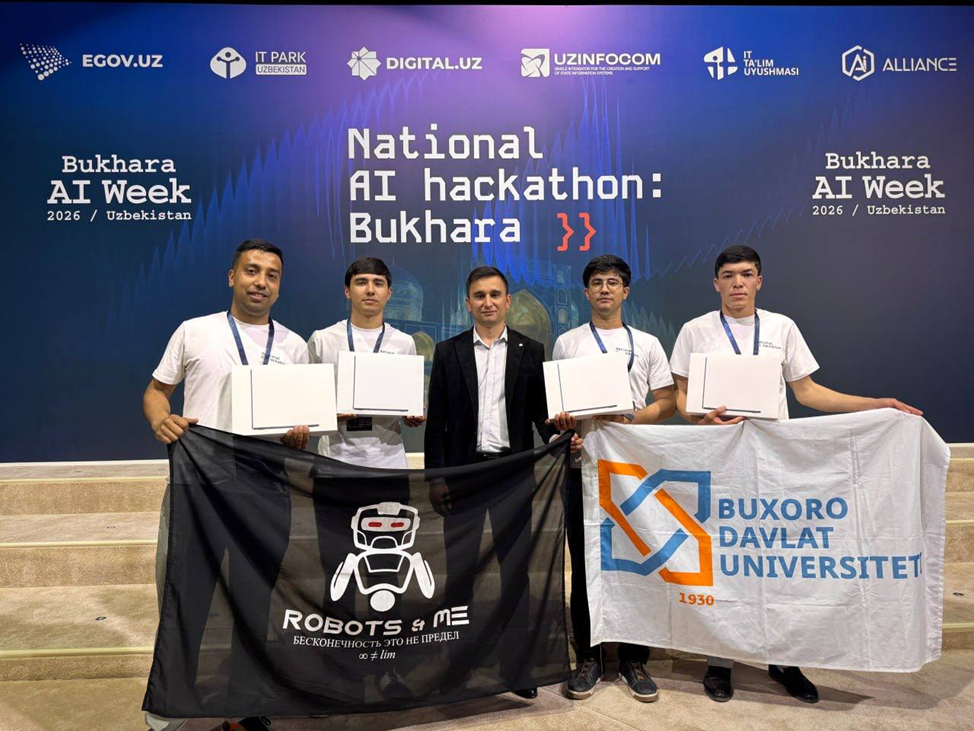
At the festival held in Tashkent on April 28–30, 2026, the BSU “BuxDU Robots and Me” team won awards in several robotics categories.
In the Robot Sapper category, the team received the “Best Engineering Design Solution” award.
APRIL 2026
National AI Hackathon
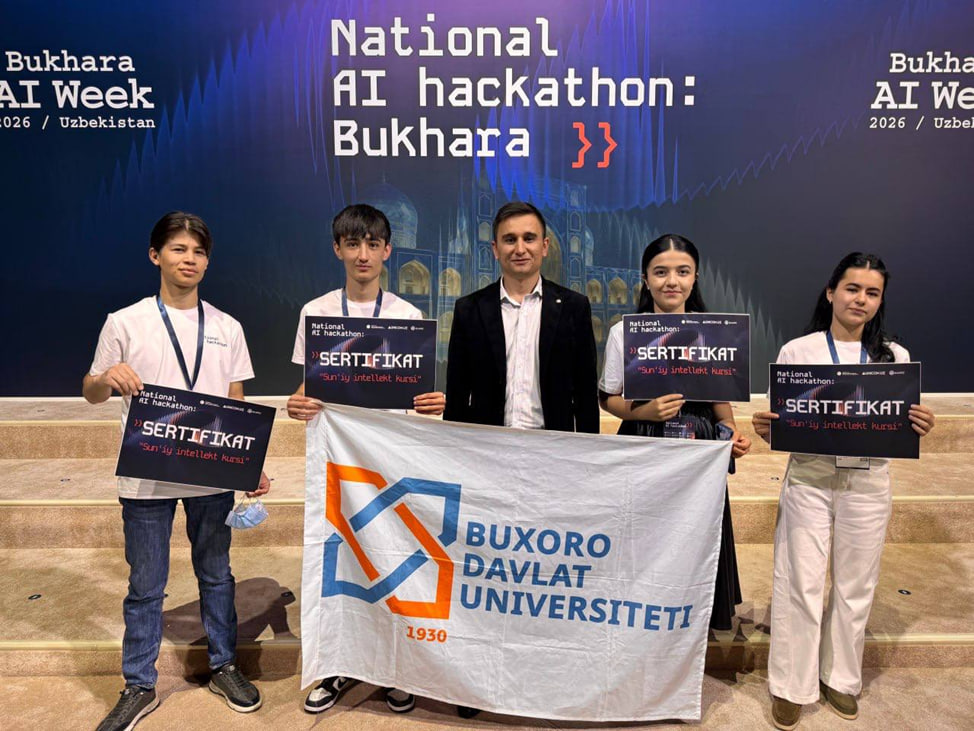
At the National AI Hackathon held in the Bukhara region on April 9–14, 2026, the “Robots and me” team won 1st place in the education category.
JUNE 2026
Academic Mobility Grant
UZS 74,495,000
Associate Professor Roziq Sodiq o'g'li Karimov won the Academic Mobility competition and received this grant.
Integration of Education and Practice
The Department emphasizes practical skills, cooperation with IT companies and educational institutions, and support for talented learners.
Academic Lyceums
Educational and methodological support for the academic lyceum associated with Bukhara Engineering-Technological Institute and the Karakul Academic Lyceum.
Secondary Schools
Teaching practice and methodological assistance in informatics and IT at schools No. 8, 17, 23, 35 and 39 in Bukhara.
Strategic Priorities
Modern EducationPreparing specialists in applied mathematics, software engineering, and computer science.
Innovative ResearchDeveloping software products, startups, mathematical models, and AI-based practical projects.
International IntegrationExpanding international partnerships, academic mobility, and support for young researchers.


 buxdu_rektor@buxdu.uz
 (+998) 65 221-30-46


 EN
 UZ
 RU
 ZH-CN