11.01.2025
Program Design and its Confirmation
.
1. Program Design Approach
At Bukhara State University, academic programs are designed based on students’ needs, labor market demands, and national and international qualification frameworks (NQF, EQF). The program content is aimed at integrating academic knowledge with practical skills.
Process of Developing New Academic Programs
The development of an academic program begins with a needs analysis, during which the regional and international labor market conditions in the relevant field are thoroughly examined. Based on the results of this analysis, competencies that meet contemporary requirements are identified. Subsequently, consultations are held with stakeholders—including employers, industry experts, alumni, and student representatives—and their feedback and recommendations are taken into account in refining the program content. Finally, the academic program is aligned with the requirements of the Ministry of Higher Education of the Republic of Uzbekistan and national qualification standards, and harmonized with the relevant regulatory documents.
2. Program Objectives and Learning Outcomes
The qualification requirements defined for each academic program consist of several key components. First, the overall objectives of the program are established, encompassing elements such as the level of professional training, a research-based approach, analytical thinking skills, and social responsibility. Based on these general objectives, learning outcomes are developed and formulated in a document that reflects knowledge, skills, and competencies. In addition, learning outcomes are linked to relevant modules, and clear assessment criteria are defined for each module, ensuring transparency and quality in the teaching and learning process.
3. Curriculum
The academic program is developed in line with modern requirements and applies a modular approach based on the ECTS credit system. The curriculum includes compulsory courses, elective courses, and internship/practical training components. In addition, procedures are established for the preparation and defense of a bachelor’s thesis at the undergraduate level and a master’s dissertation at the graduate level.
For each academic program, a separate program guide is developed, which includes the following information: module content and learning objectives, forms of instruction and assessment methods, as well as the alignment of the module with the intended learning outcomes. This approach enables clear definition and effective assessment of the competencies that students are expected to achieve.
4. Program Approval Procedure
Updated academic programs are approved in accordance with a step-by-step procedure. Initially, the draft program is developed by the relevant department. The draft is then discussed at the faculty academic and methodological council and enhanced with relevant recommendations. Subsequently, the program is reviewed and approved by the university-level academic and methodological council.
5. Process of Considering Feedback and Recommendations
In the process of continuous improvement of academic programs, analytical work is carried out based on multiple sources. First and foremost, student feedback is regularly collected through surveys and focus groups, enabling the identification of the needs and suggestions of the primary participants in the educational process. In addition, the labor market outcomes of graduates—such as employment rates and relevance of employment to their field of study—are analyzed. Furthermore, practice-oriented feedback and recommendations from employers serve as an important factor in updating program content. Recommendations provided during previous accreditation processes are also taken into account, and necessary changes are implemented accordingly.
Actions Taken to Improve Educational Quality (2023 Survey)
Actions Taken to Improve Educational Quality (2024 Survey)
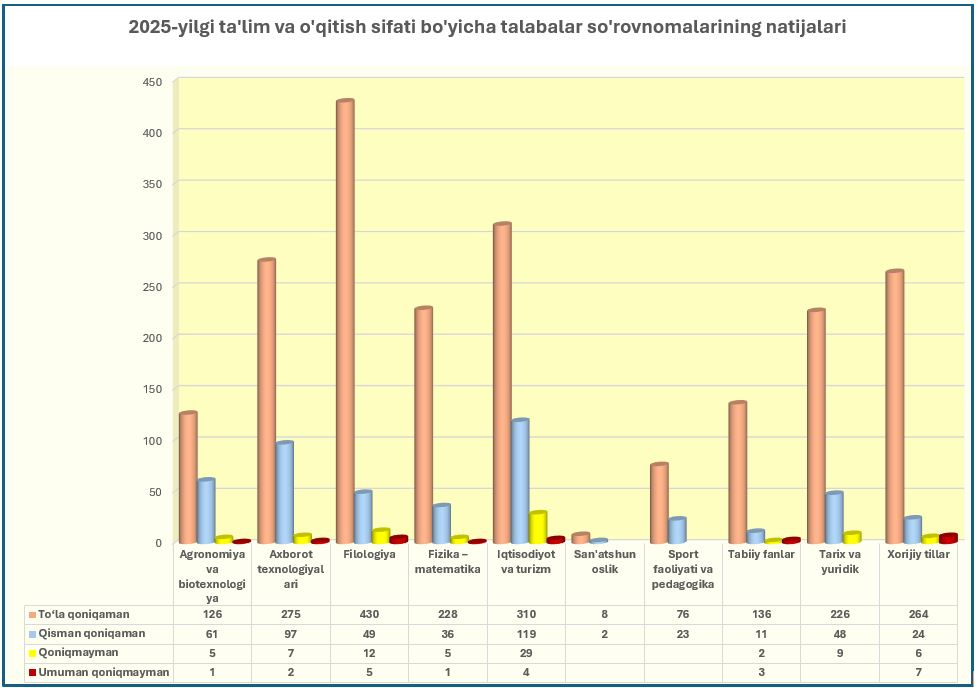
Actions Taken to Improve Educational Quality (2025 Survey)
 buxdu_rektor@buxdu.uz
 (+998) 65 221-30-46

 EN
EN
 UZ
UZ
 RU
RU
 ZH-CN
ZH-CN